A winter hike
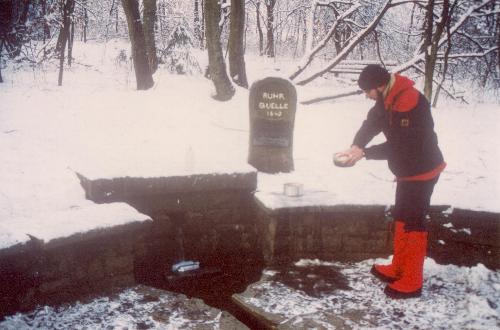
| One may get an uneasy feeling about the thought of camping in a casual German forest, drinking water from Ruhr, if there ain't too much pollution there. Actually I must say, that the river Ruhr and the surrounding landscape deserves a much better reputation than it has. As previously mentioned Ruhr rises from the Rothaar mountains at an altitude of 670m, to fall into the Rhine 135km away and 650m lower, and far the most of the distance is forest and farmland. It is correct, that the German industry had its cradle her, when 2-300 years ago they started to extract coal in what later became the Ruhr District. However, this was only minor coalmines, extracting the coal which here were close to the surface, and during the years the furnaces moved further north. However, here the coal is much deeper in the ground, and only large-scale industry is rational. As examples Duisburg, Recklingshausen and Bochum can be mentioned. These industrial centres are all in the Emscher valley and much more northerly than Ruhr, which in time has handed over its industry to the cities further north. However, this is by now more than a century ago, most tracks from the former mining industry have disappeared, and the old mining cities along Ruhr now fits nicely into the landscape without destroying it. Furthermore it should be mentioned, that the river Ruhr still is the predominant supplier of drinking water in Westphalia - although I wouldn't recommend everyone to drink it straight from the river. |
Next